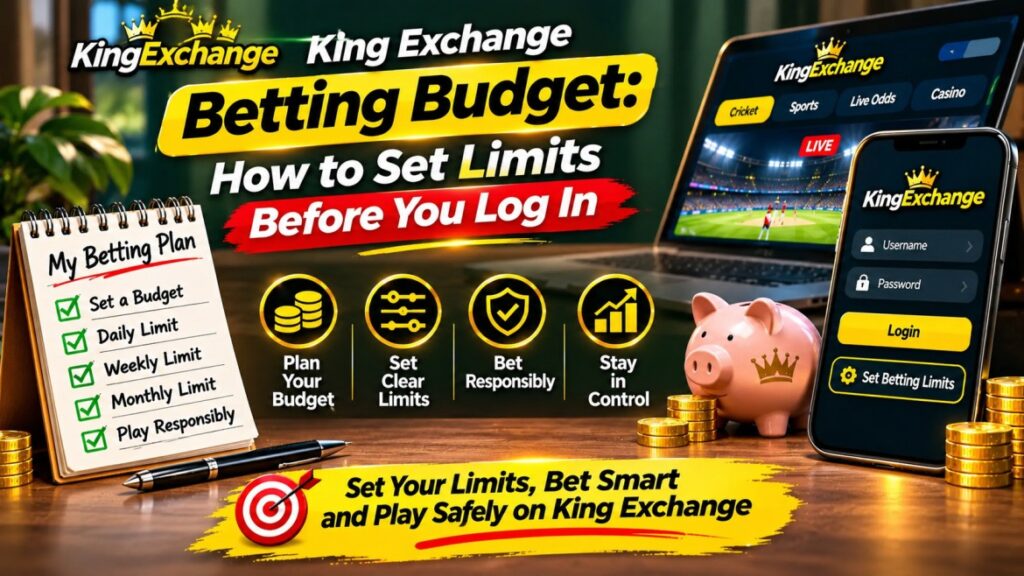
Online betting platforms offer convenience, but that convenience carries a financial risk that many users underestimate until the account balance is already depleted. King Exchange is one such platform, and like any real-money wagering environment, it rewards users who arrive with a plan and punishes those who treat deposits as disposable entertainment. A King Exchange betting budget is not a restriction on enjoyment; it is the structure that makes sustained participation possible without financial strain. This guide explains how to build that budget before you ever open the login screen, which limits matter most, and how to keep the plan intact once the odds start moving.
Why a King Exchange Betting Budget Must Exist Before Login
The moment between entering your password and placing the first wager is where most budgets fail. Once inside the dashboard, balances are visible, markets are live, and the psychological pull of a quick bet is strongest. A King Exchange betting budget created after login is not a budget at all — it is a reaction to whatever balance happens to be sitting in the wallet. The plan has to be written down, decided, and fixed before the session begins, because decisions made under the influence of live odds are rarely rational.
Platforms like King Exchange are designed to make depositing easy. UPI, e-wallets, and card payments process in seconds. That ease is precisely why the spending ceiling needs to be set elsewhere — outside the platform, in a place where deposit buttons are not one tap away.
Defining the Three Limits That Form the Core of the Budget
A workable King Exchange betting budget rests on three separate numbers. Treating them as one figure is a common error that leads to overextension.
The Deposit Limit
This is the amount you are willing to transfer into the platform during a defined period — a week, a fortnight, or a month. The deposit limit answers a simple question: how much money can leave your bank account for betting without affecting rent, bills, savings, or family obligations? A practical rule is to calculate disposable income after fixed expenses, then allocate a fraction of that remainder to betting. If the fraction feels uncomfortable, it is too high. The deposit limit is a ceiling, not a target to be reached every week.
The Session Limit
A session limit caps how much of the deposited balance can be committed during a single login. This number is smaller than the deposit limit and exists to prevent a single evening from consuming the entire weekly allocation. For example, if the weekly deposit limit is ₹2,000, the session limit might be ₹500. This forces a natural pause between sessions and interrupts the momentum that drives chase betting.
The Loss Limit
The loss limit is the most important of the three and the one most frequently ignored. It states the maximum amount you are prepared to lose before closing the platform for the day, regardless of how much remains in the wallet. A loss limit converts a bad session into a bounded event rather than an open-ended spiral. Once the loss limit is hit, the session ends — no exceptions, no “one more bet to recover.”
Calculating a Realistic Figure Without Guesswork
A King Exchange betting budget built on guesswork collapses the first time an unexpected expense appears. The calculation should follow a fixed sequence.
Begin with monthly take-home income. Subtract rent or mortgage, utilities, loan repayments, insurance, groceries, transport, and any dependent costs. What remains is discretionary income. From that figure, subtract savings contributions and emergency allocations — betting money should never come from either. The remaining amount is the absolute maximum available for entertainment, of which betting is one component. Allocate a portion of that to the King Exchange betting budget, keeping in mind that other leisure activities also draw from the same pool.
Two figures should never appear in this calculation: borrowed money and credit. A budget funded by a credit card or a loan from a friend is not a budget; it is deferred debt with an interest cost attached.
Keeping the Budget Separate from the Platform
The structural weakness of any betting budget is proximity. Money held inside the platform wallet feels less real than money in a bank account, and the deposit button makes topping up effortless. A King Exchange betting budget survives only if the funds are kept outside the platform until they are needed.
The practical approach is to deposit only the session limit at the start of each session rather than the full weekly amount. This creates a physical barrier between intention and action. If the session limit is exhausted, the wallet is empty, and the only way to continue is to make a deliberate new deposit — a decision that is much easier to refuse than an idle top-up. Some users go further and remove saved payment details from the device, so each deposit requires manual entry of card or UPI information.
Building the Budget Into a Written Agreement
Verbal intentions fade. A King Exchange betting budget written down and kept visible — on paper, in a notes app, or as a screenshot — carries more weight because it can be reviewed and compared against actual behaviour. The written record should state the deposit limit, session limit, loss limit, and the time period each applies to. It should also state the consequences of breaching a limit, such as a one-week suspension from the platform.
Reviewing the record at the end of each month reveals patterns that memory obscures. If the loss limit was breached three times in four weeks, the budget is not working, and the limits need to be lowered rather than rationalised.
Recognising When the King Exchange Betting Budget Is Being Tested
Certain situations reliably pressure a budget. Chase betting after a significant loss is the most common. Extending a session past the planned time because a match is “almost decided” is another. Increasing stake size after a winning streak, on the assumption that the run will continue, is a third. Each of these behaviours signals that the King Exchange betting budget is being overridden by emotion rather than logic.
The countermeasure is a cooling-off rule. When the urge to breach a limit appears, a fixed pause — leaving the device for thirty minutes, or stepping outside — is usually enough to let the impulse pass. Platforms increasingly offer self-imposed deposit limits and time-out tools; activating these before the first session adds an external layer of enforcement that does not depend on willpower alone.
Aligning the Budget with Responsible Platform Use
A well-constructed King Exchange betting budget complements the platform’s own safeguards rather than replacing them. King Exchange, like other licensed operators, provides deposit limits, session reminders, and self-exclusion options. Setting the platform’s built-in deposit limit to match the external budget creates a double barrier: even if the written plan is forgotten in the heat of a session, the system will refuse the deposit.
Users should also verify that they are accessing the correct official domain before logging in, since lookalike sites using similar names have been flagged for security risks. Entering credentials or payment details on an unverified domain exposes both funds and personal data, and no budget can protect against a compromised account.
What a Sustainable Routine Looks Like
A user operating a functioning King Exchange betting budget follows a recognisable pattern. The budget is reviewed and set at the start of each month. Deposits are made in session-sized amounts rather than lump sums. Loss limits end sessions early rather than late. Wins are withdrawn periodically instead of being recycled endlessly into new wagers. Records are checked against actual transactions, and limits are adjusted downward when breaches occur.
This routine is unglamorous. It produces no dramatic winning streaks and no spectacular recoveries. What it produces instead is a betting habit that can continue for years without damaging financial stability — which is the only version of online betting that makes sense.
The King Exchange betting budget is the single most effective tool available to anyone using the platform. It converts an open-ended financial exposure into a controlled, reviewable, and adjustable plan. The deposit limit defines what can enter the platform, the session limit governs how quickly it can be committed, and the loss limit draws a hard boundary around a bad day. Written down, kept outside the platform, and reinforced with the site’s own deposit controls, these three numbers do more to protect a user than any betting strategy ever will. A King Exchange betting budget set before login is the difference between entertainment with a defined cost and a habit with an undefined one.
